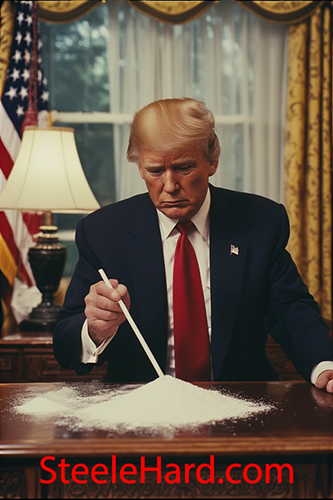
Drug Addictions Plague the Wealthy and it’s Your Problem
Drug addictions plague the wealthy far more than the majority of people aware and it’s hidden in plain sight. Erratic behaviors and physical appearances that would cause most people to suspect drug abuse in the poorer classes are overlooked when it comes to the wealthy. The general public would rather believe a beloved icon, or leader is simply eccentric. Complicating the pursuit of information is that no one is specifically compiling inform on social class and addiction.
The Trinity of Suspicion
Associations-Symptoms-Behavior
It’s a well-known truism that habitual drug users tend to associate with other addicts and criminals. Therefore, it’s no surprise that President Donald J. Trump is rumored to have a drug addiction. But what’s not a rumor is the type of people he associates with do use illegal narcotics, distribute them or both.
Apart from the obvious Jeffrey Epstein, the President is also closely linked to Semion Yudkovich Mogilevich, an international crime lord infamous for drug trafficking and other offences too numerous to list. Closer to home, Trump is friends with Vince McMahon. Mr McMahon is accused of defecating on a former employee, Janel Grant, while high and engaged in a 3some with another male. There’s also Matt Gaetz, who was nominated by the President to be the Attorney General in 2024. Since then, Mr. Gaetz has been under investigation for sex with a minor and illegal drug usage.
The POTUS often finds himself answering questions about the people he chooses to associate with. P. Diddy even thought he had a relationship close enough to the President to request a pardon for his crimes. But more convincing evidence is when colleagues break NDA agreements. Like celebrity Noel Cassler who worked with Donald Trump on the show ‘The Apprentice’. He has stated that President Trump abused cocaine and prescription Adderal.
While associations can create suspicion, physical evidence is always preferred. Perhaps the most damning of which is his skin discoloration and erratic behavior. The fake “healthy glow” of bronzer has made him a characture for mock and ridicule. For someone with image consultants, not to use a professional makeup artist, doesn’t make sense, unless he needs to hide something. Indeed, there has been much scrutiny concerning his health in recent years. In January of 2024, Trump appeared with bright red marks on one hand. While secondary syphilis was speculated, no other explanation was explored. But the marks are also consistent with post surgical healing of a digital sympathectomy.
This treatment is for digital ischemia, a severe circulatory problem that can be brought on by prolonged drug use. When you add to this equation the recent alternating bruises on the back of Trumps hands, repeated or prolonged use of an IV comes to mind, not general clumsiness. Long term drug use does create toxicity of the liver and all of Trump’s physical symptoms support a failing system.
His behavior has also greatly changed since his 1st term in office. Aggressive, easily agitated and demanding praise from those around him have become amplified. Within a year, he’s alienated allies, threaten war against others and deployed a heavily armed militia against the US citizens, which have caused deaths of innocent people. For a prosecuting lawyer, President Trump has a perfect trinity for suspicion: association, physical signs and behavior.

The Davos Effect
However, the experiences of sex workers provides a treasure trove of data. Escorting is a recognized profession in Switzerland and as such there is no fear of legal blow back from reporting incidents there. So whenever the WEF meets a surge of escorts come with it.
A Specialized Center on Trafficking in Women (Fachstelle Frauenhandel und Frauenmigration. aka FIZ) says that in the weeks following the WEF they receive an increase in the number of reports of violence and exploitation, from encounters during the event. “We know from experience that where a lot of money and power come together, the demand for paid sex increases. A Swiss Coordination Unit against Trafficking (KSMM) confirm the pattern observed by FIZ. Finally the Salvation Army is also being vocal about the increase in calls to their national trafficking helpline during and after the WEF. While there are no exact numbers, these organization validate that during the Davos event, there is an abundance of sex workers present and interfacing with the wealthy elites and ruling class.
It’s the prostitute’s personal experiences with the upper social stratas that are of interest. They provide a glimpse into the personalities and habits of those society has labeled their ‘Leaders.’ Unsurprizingly, a few sex workers have stated, “Many who attend the World Economic Forum only do so for the perversion that they can find.”

These escorts will also point out that the higher the price paid to “party” the wilder the encounter. Participation is expected, both in sharing “party favors” and oneself. To state this more bluntly, they’re not interested in saving the world, but rather to fuck and / or “get fucked-up”.
The Party Culture and Illicit Drugs
For the ruling classes, drug use is less often a private matter; it becomes a social activity. In certain elite social circles, particularly within the entertainment industry, fashion, and political elites, drug use is often normalized as part of the social fabric. Dr. Alan Miller, a sociologist who studies drug use in affluent communities, argues, “The culture of excess in elite circles promotes drug use as an activity of indulgence and sophistication. The use of substances like cocaine, ecstasy, and even designer drugs such as MDMA has become a social norm among wealthy individuals, especially in party or club environments” (Miller, 2020).
Cocaine, a drug historically associated with the rich, is one of the most common illicit substances used by the wealthy. The high cost and perceived prestige of cocaine contribute to its appeal in elite circles. Former drug counselor and author Peter D. Schultz points out, “Cocaine was once seen as a drug of luxury, its use among the elite becoming a symbol of high status. Even today, it remains prevalent in certain segments of wealthy society, where its use is often seen as a reflection of social power rather than a symptom of addiction” (Schultz, 2012).
The Hidden Nature of Addiction in Wealthy Circles
One of the defining characteristics of drug addiction in affluent groups is its concealment. As sociologist Dr. Sarah McCollum notes, “Substance abuse in affluent circles is frequently hidden behind wealth and status, making it difficult to track and often leading to a misconception that the wealthy are not affected by addiction” (McCollum, 2016). Furthermore, the most common elite addictions are alcohol and prescription drugs both of which can appear innocuous to the public. Especially when direct access to the elites is mitigated behind handlers. Or Doctors manage the prescription abuse.
Prescription drugs, especially opioids, benzodiazepines, and stimulants, play a major role in substance abuse among the wealthy. Dr. Maria Hernandez, a psychiatrist who works with high-profile clients, has commented, “The misuse of prescription medications like opioids is rampant among wealthy individuals. They often have access to these medications through their physicians, and many use them recreationally or to manage the emotional and mental toll of their lifestyles” (Hernandez, 2018).
The Threat of Addiction to Others
“Not my Brother’s keeper” is often the adage concerning addiction when it comes to the poorer classes. However, the scope of influence and power wielded by the elites makes their addictions everyone’s problem. Sexual addictions lead to the scandalous sex trafficking of Epstein and company. Acute alcoholism leads to cognitive impairment and organ failure as was witnessed with Russia’s ill-fated leader Boris Yeltsin. Likewise long term drug abuse takes it’s toll on the mind and body, causing erratic behavior or paranoia, all the while shortening one’s lifespan. According to an article run in the Guardian, written back in 2000, Nixon, America’s only President to ever leave the office in disgrace had problems with both alcohol and prescription drugs.
As the economic gap widens, everyday people are subject to the whims of the elites more than ever. Desperate to make sense of dwindling resources, it is too easy to blame the scapegoat offered by the leaders, calling all the shots and reaping all the profits. Their self-confidence and media might, bring out the boot-lickers hoping to ride their coat-tails into the center of their sphere of influence.
This misplaced idolitry has the added benefit of dividing society. Not into the have and have-nots, as evidence would dictate. But by dividing the have-nots among themselves, so that they…we are easier to manage.
Our leaders are just as fallible as we are. With their wealth and power, they can and often do, create far more harm to innocent people than a dozen homeless junkies and their dealers could ever manage.
Read Also Legalized Murder
References:
• McCollum, S. (2016). Substance Abuse in Affluent Communities: The Invisible Epidemic. Journal of Sociology, 42(3), 190-205.
• Waters, J. (2014). Addiction and Recovery in High Society. New York: HarperCollins.
• National Institute on Alcohol Abuse and Alcoholism (NIAAA). (2020). Alcohol Use and its Social Impacts: A Report on the Prevalence of Alcohol Abuse. Retrieved from www.niaaa.nih.gov.
• Hernandez, M. (2018). Prescription Drugs and the Wealthy: A Growing Crisis. Psychiatric Journal, 26(4), 123-136.
• Roth, E. (2017). The Role of Luxury Rehab Centers in Addiction Treatment. Journal of Addiction Recovery, 10(1), 45-58.
• Miller, A. (2020). Social Dynamics of Drug Use Among the Elite. Sociological Review, 53(2), 200-215.
• Schultz, P. D. (2012). The Myth of Cocaine as a ‘High-Society’ Drug. Addiction Research & Theory, 20(5), 451-460.
• Miller, A. F. (2009). Opium and Power: The Historical Use of Drugs Among the Elites. Historical Sociology, 32(1), 30-45.




 by
by 