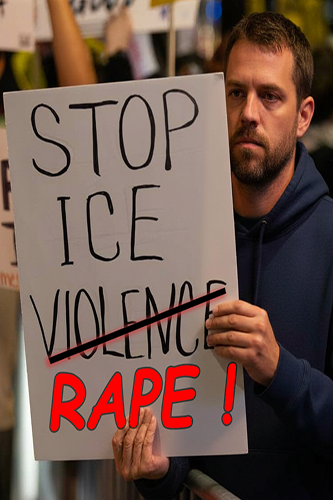
ICE versus the Nazis: History Repeats
ICE versus the Nazis is a chilling reminder that history repeats itself. The world is once again experiencing a terrifying rise to authoritarianism and a public happily willing to be its servants. Nazi German was a democracy that embraced the vision of a mad man and now the United States appears to be following in humanity’s ugliest documented past. The question isn’t why? But how do we respond?
Will future historians say we stepped back from the brink of destruction or will these events be catalogued as precursors to another of the human atrocities they study. For the record, several Las Vegas odds makers are saying to bet on society’s future holocaust.

The ironic horror of our current situation is that the President of the United States was raised by the generation who stood against authoritarianism. His parents witnessed the barbarous crimes against humanity of Germany’s holocaust, Japan’s Unit 731 human experiments and Italy’s concentration camps in Libya. When World War 2 ended, they breathed a sigh of relief and swore, “Never Again.” Yet, society is once again walking down the same dark road which once forced Anne Frank into hiding from the Gestapo.
What the media won’t tell you
Immigration is a civil matter and not criminal
Overwhelmingly, immigration enforcement is civil in nature. The main goal is regulatory and not to punish. Cases are heard in immigration courts, which are part of the Executive Office for Immigration Review (EOIR), a branch of the Department of Justice. They are not part of the federal judiciary’s criminal court system. Immigration, as in all civil cases, follow the rule of “preponderance of the evidence” (more likely than not), instead of the criminal standard of “beyond a reasonable doubt.” Typically these cases involve either removal (deportation) or the granting of a benefit. While detention can occur, it was considered administrative, not punitive.
Under U.S. federal law, the most frequently prosecuted immigration crime is illegal re-entry under 8 U.S.C. § 1326, which makes it a felony to return to the United States after formal deportation, even though first-time unlawful presence alone is not criminal under that statute. Other immigration-related crimes include fraud and false statements, such as using counterfeit documents or lying to obtain a visa. As well as entering into sham marriages for immigration benefits, and smuggling or harboring unauthorized individuals under 8 U.S.C. § 1324, which are serious felonies. Assaulting or interfering with an immigration officer in the performance of official duties is also a crime. Collectively, these offenses differ from mere unlawful presence because they require affirmative criminal conduct involving deception, defiance of prior removal orders, or actions that endanger others.
A crime against humanity
Renee Good was therefore murdered because there is no valid justification for an armed enforcement. She was obviously not what ICE has interest in detaining, yet officers were enraged that she did not “respect their authority”. Government is sending heavily armed agents to handle a simple civil issue, like a dispute over paperwork or regulations. By using armed force for a non-criminal matter and aggressively stopping random people, they created a tense and dangerous situation. You can’t claim self-defense when you are the one who started the illegal confrontation. The agents had no right to be demanding proof over a civil issue in the first place. Because the whole operation was an abuse of power, the agent’s fear isn’t a legal excuse. He put himself and others into that volatile situation by breaking the rules of his job and the constitution. Using the power of the state to commit such a reckless killing for no good legal reason is one of the most serious crimes possible, arguably a crime against humanity
Besuch von Onkel Heinrich /A visit from Uncle Heinrich
A grim euphemism for a Gestapo arrest or house search.
The processes of state-sponsored exclusion: the discursive construction of an “other,” the creation of legal exceptions, the bureaucratic management of persecution, and the tactical infliction of terror. ICE is being used not just to enforce immigration law but to systematically target people based on perceived group identity (immigration status and ethnicity). This is compared to the early Nazi use of the Gestapo and other state organs to single out Jews and minorities for removal from society.
Both the 3rd Reich and President Trump’s ICE involve:
Like the 3rd Reich, Trump’s ICE (he has doubled the number of agents this term) go after people identified as “undesirable” by the state. Some critics place weight on rhetoric used by Trump and his supporters that frames undocumented immigrants as threatening “others” who must be removed or controlled. They argue that “othering” language, portraying a group as a danger to the nation, was a hallmark of Nazi propaganda against Jews and others and that this dynamic is present in modern political discourse around immigration enforcement.
Labeled as Criminals their status is justification for the loss of ordinary legal protections. Yet the reality is that over 70% of detainees who get their hearing in immigration court have no record, not even a traffic violation. Looking at the American populas in comparison, where 1 in 3 have some sort of record, these people generally are MORE law abiding. Which isn’t surprising since the last thing these targeted groups want is confrontation with any type of police force. Advocates of the comparison frame this as an erosion of individual rights in favor of “state-defined enemies.” (Mediaite)
Perception of “Secret Police”-like Tactics
Many critics, politicians, commentators, activists, say recent ICE operations resemble secret police tactics rather than traditional law enforcement. They draw a parallel to Nazi Germany’s Gestapo (the Nazi secret state police). Specifically, ICE has been known to operate out of uniform or with ambiguous identification. They engage in raids and roundups without clear advance notice. There are ongoing mass detentions in communities based on broad criteria. This framing is used to argue that the style of enforcement is reminiscent of how the Gestapo operated early in the Nazi regime. (People.com)
Loss or Erosion of Due Process Protections
Critics highlight that many ICE actions under Trump involve detaining individuals without formal charges. Many of the roundups themselves are warrant-less, broad interior enforcement sweeps. As well, detainees have had limited access to legal counsel. Critics argue this undermines constitutional protections and could be seen as the early erosion of due process, similar to how the Nazis removed legal protections from Jews and other minorities before later atrocities. (VisaVerge)
Opponents contend that the deployment of ICE agents in large “surge” operations (e.g., in cities like Minneapolis, Chicago, and Los Angeles) creates fear and terror in immigrant communities. They assert that the psychological effect, fear of being apprehended at work, in neighborhoods, or while driving, echoes how Nazi measures instilled fear in targeted populations before and during their consolidation of power. (The Washington Post)

Critics argue that such unchecked power concentration and escalation resemble early stages of authoritarian policing rather than routine law enforcement.
Important Clarifications
The purpose of the above comparisons isn’t to claim equivalence to the systematic genocide of six million Jews. Instead, it’s to argue structural or process parallels. The erosion of due process, increased power for enforcement agencies, and targeting of a group defined as “other.” It resembles the early stages of how authoritarian regimes consolidate control using policing apparatuses. People also need to realize that Jews weren’t the only ones to die at the hands of the Nazis. The Jews were the catalyst, the us vs them tactic to elicit public participation. However, the reality was that anyone who remained in Nazi territory and did NOT participate in Nazi regimes risked being included among the undesirables. A label which as Renee Good found out, justifies murder for authoritarian governments.
Sources
Gavriel D. Rosenfeld, Hi Hitler! How the Nazi Past is Being Normalized in Contemporary Culture (Cambridge University Press, 2015), 2-5.
Timothy Snyder, On Tyranny: Twenty Lessons from the Twentieth Century (Tim Duggan Books, 2017).
Saul Friedländer, *Nazi Germany and the Jews, 1933-1945* (Harper Perennial, 2009), Part I.
David Welch, The Third Reich: Politics and Propaganda (Routledge, 2002), 112-120.
Ervin Staub, The Roots of Evil: The Origins of Genocide and Other Group Violence (Cambridge University Press, 1989).
“Full Text: Donald Trump Announces a Presidential Bid,” The Washington Post, June 16, 2015.
Josh Dawsey, “Trump Derides Protections for Immigrants from ‘Shithole’ Countries,” The Washington Post, January 12, 2018.
Aaron Blake, “Trump’s ‘Infestation’ Remark and the Long History of Comparing Immigrants to Pests and Parasites,” The Washington Post, June 19, 2018.
Christopher R. Browning, Ordinary Men: Reserve Police Battalion 101 and the Final Solution in Poland (HarperPerennial, 1998), xviii.
Friedländer, Nazi Germany and the Jews, 141-149.
Giorgio Agamben, State of Exception (University of Chicago Press, 2005).
Caitlin Dickerson, “Separation of Families at the Border: What We Know,” The New York Times, June 19, 2018.
Human Rights Watch, “US: ‘Remain in Mexico’ Program Tramples Asylum Seekers’ Rights,” February 7, 2020.
Shoba Sivaprasad Wadhia, Banned: Immigration Enforcement in the Time of Trump (NYU Press, 2019).
“Investigation of Private Prison Companies Shows Lobbying for Tougher Immigration Laws,” National Public Radio, August 3, 2016.
Marion A. Kaplan, Between Dignity and Despair: Jewish Life in Nazi Germany (Oxford University Press, 1998).
Miriam Jordan, “In Largest ICE Raid in a Decade, Nearly 700 Arrested at Mississippi Food Plants,” The New York Times, August 7, 2019.
“Memorandum on Enforcement of the Immigration Laws to Serve the National Interest,” DHS, February 20, 2017.
“Listen to Children Who’ve Just Been Separated From Their Parents at the Border,” ProPublica, June 18, 2018.
“The Science is Clear: Separating Families Has Long-term Damaging Psychological and Health Consequences,” American Psychological Association, June 14, 2018.
“AAP Statement on Protecting Immigrant Children,” American Academy of Pediatrics, June 14, 2018.
Nikolaus Wachsmann, KL: A History of the Nazi Concentration Camps (Farrar, Straus and Giroux, 2015).
“ICE Fiscal Year 2019 Enforcement and Removal Operations Report,” U.S. Immigration and Customs Enforcement.
“Code Red: The Fatal Consequences of Dangerously Substandard Medical Care in Immigration Detention,” Human Rights Watch, June 20, 2018.
“ICE Deaths: Immigration Agency Fails to Follow Own Policies, Medical Experts Say,” The Guardian, December 2, 2019.
Andrea Pitzer, “Why I compared border detention centers to concentration camps,” The Washington Post, June 28, 2019.
See, e.g., Trump v. Hawaii (2018) and lower court injunctions on DACA and asylum policies.
Hannah Arendt, The Origins of Totalitarianism (Schocken Books, 1951), Chapters 9-10.
Timothy Snyder, The Road to Unfreedom: Russia, Europe, America (Tim Duggan Books, 2018).





 by
by